domingo, 24 de junio de 2012

The Price of Inequality: How Today's Divided Society Endangers our Future


The top 1 percent of Americans control 40 percent of the nation’s wealth. And, as Joseph E. Stiglitz explains, while those at the top enjoy the best health care, education, and benefits of wealth, they fail to realize that “their fate is bound up with how the other 99 percent live.”
Stiglitz draws on his deep understanding of economics to show that growing inequality is not inevitable: moneyed interests compound their wealth by stifling true, dynamic capitalism. They have made America the most unequal advanced industrial country while crippling growth, trampling on the rule of law, and undermining democracy. The result: a divided society that cannot tackle its most pressing problems. With characteristic insight, Stiglitz examines our current state, then teases out its implications for democracy, for monetary and budgetary policy, and for globalization. He closes with a plan for a more just and prosperous future.

Several months before Occupy Wall Street, the Nobel Prize-winning economist Joseph Stiglitz wrote "Of the 1%, by the 1%, for the 1%," an article for Vanity Fair. He returns to the subject in his new book looking at how inequality is now greater in the United States than any other industrialized nation. He notes that the six heirs of the Wal-Mart fortune command wealth equivalent to the entire bottom 30 percent of American society. "It’s a comment both on how well off the top are and how poor the bottom are," Stiglitz says. "It’s really emblematic of the divide that has gotten much worse in our society." On Tuesday, Bloomberg News reported that pay for the top CEOs on Wall Street increased by more than 20 percent last year. Meanwhile, census data shows nearly one in two Americans, or 150 million people, have fallen into poverty or could be classified as low-income. "United States is the country in the world with the highest level of inequality [of the advanced industrial countries], and it’s getting worse," Stiglitz says. "What’s even more disturbing is we’ve [also] become the country with the least equality of opportunity."

Crisis in Spain


Because of the dramatic increase in construction of new homes and the long time between the beginning and end of a construction project, by the time the demand for housing had slowed in 2007, available housing was just reaching its peak. By this time, construction accounted for 13 percent of total employment in Spain. When prices began falling and housing demand halted, unemployment jumped up 10 percent.
As unemployment skyrocketed, so did unemployment benefits. In a welfare state like Spain, unemployment benefits are generous. However, what was a sustainable unemployment level quickly became a drain on the Spanish government. The reduction in the Spanish government’s tax revenue, which is heavily dependent on real estate, exacerbated the problem. These drains on the economy turned a previous budget surplus of over 2 percent of GDP into a deficit of almost 4 percent of GDP, violating the limits of the Pact.

Spanish regional savings and loan banks, called cajas, account for half of Spain’s banking system. There are around 24,000 branches of cajas throughout Spain to serve its 46 million residents (one branch for approximately every 1,900 people). The United Kingdom, in comparison, with a population of around 62 million, has only 10,000 total bank branches (one branch for every 6,200 people). Cajas are not publically traded, and usually regional politicians control the cajas instead of shareholders. The majority of cajas’ clients are families, small and medium-sized business, and non-governmental organizations such as health care facilities, environmental groups, and cultural groups. Before the crisis, cajas often loaned to those that the larger banks turned away because they were considered “undesirable”—clients that were less likely to pay back their loans. Unlike the rest of the banking system, cajas were relatively unregulated, and they were not required to disclose certain information such as collateral on loans, repayment history, and loan-to-value ratios. This nondisclosure prevented the Spanish government from understanding cajas’ financial situations before and during most of the crisis. The government was also unaware of the depth of cajas’ investment in the real estate market.

When Spain’s two largest banks, Santander and BBVA, slowed lending in 2007, the cajas continued to lend heavily into the cooling housing market. By 2009, cajas owned 56 percent of the country’s mortgages, and loan payments from property developers accounted for one-fifth of the cajas’ assets. Because the cajas were not required to disclose much of their investment information to the government, their continued lending to the real estate market went relatively unchecked.

Black physicians treating in the ER a member of the Ku Kux Klan.


Description of photo: Black physicians treating in the ER a member of the Ku Kux Klan.

I found this photo on the internet and decided to upload it to my Blog. I think it's unusual and ironic the situation.
What do you think?

domingo, 17 de junio de 2012

Strong adjustments to imports.. We are not allowed to import Mobiles..


The Government introduced an amendment to tariff and import quota of more than 100 products since last Friday.
Through three resolutions (63, 66 and 67) the Committee of Foreign Trade (Comex) set the new measures. The first document sets tariffs for products made from those TVs, snuff, paper, cardboard, hair clippers, combs, cameras, brushes, etc..
Another of those items which are covered by the measure of malt beer, sparkling wine, cider and other alcoholic drinks, such as creams, brandy and vodka, which went to pay a tariff ad valorem (on value) of 20 % to pay a fee of 1% mixed and $ 0.25 per degree alchólico. Within this measure are 20 spirits.
They are also in Resolution 63 and videorreproductores TVs, including 22-inch plasmas and 50 inches, which will pay ad valorem tariff of between 5% and 20%, plus a specific tariff of between USD 73.11 and USD 158 , per unit. The washing machines, meanwhile, rose 15% to 25% per unit, as determined by the document.
The other two resolutions provide for quota in value and units for 38 importers of vehicles (see note below shared) and 33 cell phones (including the inability to bring phones via courier / mail or passenger). Among the buyers affected by this measure is Andrew (name withheld), who is set an annual quota of 296 units and $ 21 7679.31. "We already surpassed that quota (700 units in half a year) and what we will do is stop playing to sell what we have and stop. This forces you to make staff cuts from next week, because many affected by the measure "he said.
The importer said that between five and 10 small importers, as he also hit. It is considered beaten twice, as it ensures that the largest importers fees remain high, both in value and units.
Conecel (Light), for example, has an annual fee of USD 79.5 million and a million units. While Otecel (Movistar), USD 24 million and 328 541 units. Neither company wanted to comment on the restrictive measure right now.

Ecuador is one of the Latin American countries re channeled his Economic Policy


Ramon Torres, Ambassador of Ecuador in Venezuela, examines the negative impacts that have long had in Latin America external debt, subjecting them to a system that favors the banks and not people, and prevented their development. Ambassador Ecuador shows how, from the administration of President Correa, manages redirect economic management, paying much of their debt and freeing themselves from the shackles imposed this system.

Interesting government management... what do you think??

Rafael Correa, the only one who is really prepared to be the president??


What about the others??
Alvarito?
Lucio?
Not at all

Guillermo Lasso.. the only one who has the preparation to manage.. but manage a country? yes he is a successful man of the bank.. but thats is not what we need.. or it is?.. what do you think?

domingo, 10 de junio de 2012

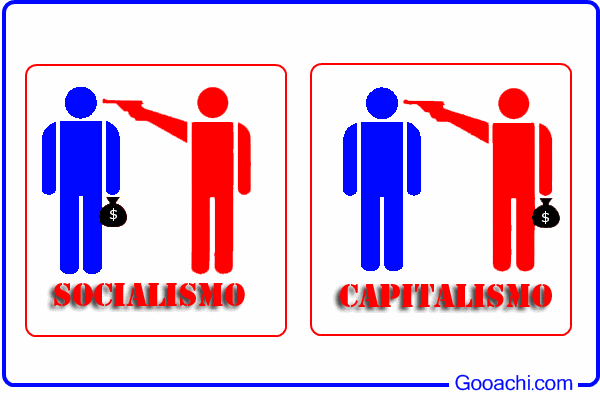
Rafael Correa.. Pure Socialism... Is that the solution for Ecuador?


The president of Ecuador, Rafael Correa, highlighted the global importance of the working class and the damage it has caused historical capitalism on this sector of the population.

Capitalism is not bad .. the bad was that there are irresponsible people who took advantage of it .. The solution is not to end capitalism and start being a Socialist country (Correa is trying to do and he is doing it) .. is to create more stringent measures that capitalism works ...