domingo, 24 de junio de 2012

The Price of Inequality: How Today's Divided Society Endangers our Future


The top 1 percent of Americans control 40 percent of the nation’s wealth. And, as Joseph E. Stiglitz explains, while those at the top enjoy the best health care, education, and benefits of wealth, they fail to realize that “their fate is bound up with how the other 99 percent live.”
Stiglitz draws on his deep understanding of economics to show that growing inequality is not inevitable: moneyed interests compound their wealth by stifling true, dynamic capitalism. They have made America the most unequal advanced industrial country while crippling growth, trampling on the rule of law, and undermining democracy. The result: a divided society that cannot tackle its most pressing problems. With characteristic insight, Stiglitz examines our current state, then teases out its implications for democracy, for monetary and budgetary policy, and for globalization. He closes with a plan for a more just and prosperous future.

Several months before Occupy Wall Street, the Nobel Prize-winning economist Joseph Stiglitz wrote "Of the 1%, by the 1%, for the 1%," an article for Vanity Fair. He returns to the subject in his new book looking at how inequality is now greater in the United States than any other industrialized nation. He notes that the six heirs of the Wal-Mart fortune command wealth equivalent to the entire bottom 30 percent of American society. "It’s a comment both on how well off the top are and how poor the bottom are," Stiglitz says. "It’s really emblematic of the divide that has gotten much worse in our society." On Tuesday, Bloomberg News reported that pay for the top CEOs on Wall Street increased by more than 20 percent last year. Meanwhile, census data shows nearly one in two Americans, or 150 million people, have fallen into poverty or could be classified as low-income. "United States is the country in the world with the highest level of inequality [of the advanced industrial countries], and it’s getting worse," Stiglitz says. "What’s even more disturbing is we’ve [also] become the country with the least equality of opportunity."

Crisis in Spain


Because of the dramatic increase in construction of new homes and the long time between the beginning and end of a construction project, by the time the demand for housing had slowed in 2007, available housing was just reaching its peak. By this time, construction accounted for 13 percent of total employment in Spain. When prices began falling and housing demand halted, unemployment jumped up 10 percent.
As unemployment skyrocketed, so did unemployment benefits. In a welfare state like Spain, unemployment benefits are generous. However, what was a sustainable unemployment level quickly became a drain on the Spanish government. The reduction in the Spanish government’s tax revenue, which is heavily dependent on real estate, exacerbated the problem. These drains on the economy turned a previous budget surplus of over 2 percent of GDP into a deficit of almost 4 percent of GDP, violating the limits of the Pact.

Spanish regional savings and loan banks, called cajas, account for half of Spain’s banking system. There are around 24,000 branches of cajas throughout Spain to serve its 46 million residents (one branch for approximately every 1,900 people). The United Kingdom, in comparison, with a population of around 62 million, has only 10,000 total bank branches (one branch for every 6,200 people). Cajas are not publically traded, and usually regional politicians control the cajas instead of shareholders. The majority of cajas’ clients are families, small and medium-sized business, and non-governmental organizations such as health care facilities, environmental groups, and cultural groups. Before the crisis, cajas often loaned to those that the larger banks turned away because they were considered “undesirable”—clients that were less likely to pay back their loans. Unlike the rest of the banking system, cajas were relatively unregulated, and they were not required to disclose certain information such as collateral on loans, repayment history, and loan-to-value ratios. This nondisclosure prevented the Spanish government from understanding cajas’ financial situations before and during most of the crisis. The government was also unaware of the depth of cajas’ investment in the real estate market.

When Spain’s two largest banks, Santander and BBVA, slowed lending in 2007, the cajas continued to lend heavily into the cooling housing market. By 2009, cajas owned 56 percent of the country’s mortgages, and loan payments from property developers accounted for one-fifth of the cajas’ assets. Because the cajas were not required to disclose much of their investment information to the government, their continued lending to the real estate market went relatively unchecked.

Black physicians treating in the ER a member of the Ku Kux Klan.


Description of photo: Black physicians treating in the ER a member of the Ku Kux Klan.

I found this photo on the internet and decided to upload it to my Blog. I think it's unusual and ironic the situation.
What do you think?

domingo, 17 de junio de 2012

Strong adjustments to imports.. We are not allowed to import Mobiles..


The Government introduced an amendment to tariff and import quota of more than 100 products since last Friday.
Through three resolutions (63, 66 and 67) the Committee of Foreign Trade (Comex) set the new measures. The first document sets tariffs for products made from those TVs, snuff, paper, cardboard, hair clippers, combs, cameras, brushes, etc..
Another of those items which are covered by the measure of malt beer, sparkling wine, cider and other alcoholic drinks, such as creams, brandy and vodka, which went to pay a tariff ad valorem (on value) of 20 % to pay a fee of 1% mixed and $ 0.25 per degree alchólico. Within this measure are 20 spirits.
They are also in Resolution 63 and videorreproductores TVs, including 22-inch plasmas and 50 inches, which will pay ad valorem tariff of between 5% and 20%, plus a specific tariff of between USD 73.11 and USD 158 , per unit. The washing machines, meanwhile, rose 15% to 25% per unit, as determined by the document.
The other two resolutions provide for quota in value and units for 38 importers of vehicles (see note below shared) and 33 cell phones (including the inability to bring phones via courier / mail or passenger). Among the buyers affected by this measure is Andrew (name withheld), who is set an annual quota of 296 units and $ 21 7679.31. "We already surpassed that quota (700 units in half a year) and what we will do is stop playing to sell what we have and stop. This forces you to make staff cuts from next week, because many affected by the measure "he said.
The importer said that between five and 10 small importers, as he also hit. It is considered beaten twice, as it ensures that the largest importers fees remain high, both in value and units.
Conecel (Light), for example, has an annual fee of USD 79.5 million and a million units. While Otecel (Movistar), USD 24 million and 328 541 units. Neither company wanted to comment on the restrictive measure right now.

Ecuador is one of the Latin American countries re channeled his Economic Policy


Ramon Torres, Ambassador of Ecuador in Venezuela, examines the negative impacts that have long had in Latin America external debt, subjecting them to a system that favors the banks and not people, and prevented their development. Ambassador Ecuador shows how, from the administration of President Correa, manages redirect economic management, paying much of their debt and freeing themselves from the shackles imposed this system.

Interesting government management... what do you think??

Rafael Correa, the only one who is really prepared to be the president??


What about the others??
Alvarito?
Lucio?
Not at all

Guillermo Lasso.. the only one who has the preparation to manage.. but manage a country? yes he is a successful man of the bank.. but thats is not what we need.. or it is?.. what do you think?

domingo, 10 de junio de 2012

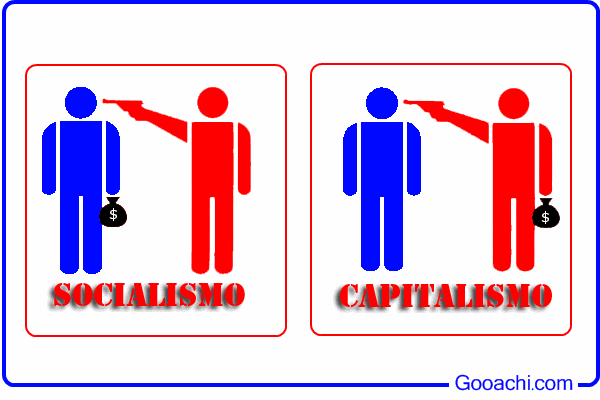
Rafael Correa.. Pure Socialism... Is that the solution for Ecuador?


The president of Ecuador, Rafael Correa, highlighted the global importance of the working class and the damage it has caused historical capitalism on this sector of the population.

Capitalism is not bad .. the bad was that there are irresponsible people who took advantage of it .. The solution is not to end capitalism and start being a Socialist country (Correa is trying to do and he is doing it) .. is to create more stringent measures that capitalism works ...


THE CAPITALIST REVOLUTION IN LATIN AMERICA

Highlights of this book

  • Latin American countries, especially Mexico, Chile and Argentina, have dramatically improved their economies since the early 80’s. The value of the Mexican stock market jumped from $15 billion in 1988 to $146 billion at the end of 1992. Argentina has controlled inflation and achieved economic growth. Chile had 8.2% economic growth in 1995 even after eleven years of continuous growth.

  • The economic benefits of the expansion have helped all levels of society. The middle class is growing, and governments are able to devote more resources to helping the poor because they are no longer paying for the losses of state owned corporations. For example, the Chilean healthcare system, which is mostly privatized, has worked. Chile’s infant mortality rates have fallen from 74 deaths to 17 deaths per thousand between 1970 and 1992.

  • The market-oriented programs have gained widespread support from the general citizenry. A December 1991 poll in Mexico found that “56 percent of the population ere favorably disposed toward the government’s reorientation of the economy to the private sector.”

  • The developed world is partially responsible for the earlier failures of Latin America’s attempts to achieve prosperity because of its insistence on failed government solutions. The World Bank estimated in a report released in 1993 that only 26% of its projects could be deemed successful. To prevent further mistakes, the World Bank and other international governmental lending organizations should be disbanded or privatized.

I am a student of Administration in UCG.. all this 3 years i saw how a lot of teachers who had their own business talk about how good is Capitalism... The real thing is that i want to start my own business and if i need to chose between Capitalism, Socialism, Communism, well, i chose Capitalism.
What do you think? 

Haiti Gold: Who will benefit?


I think there is no problem to use their natural resources to benefit themselves. The real problem is the corruption of this poor country.
Every single country of the world use their natural resources and Ecuador is one of them using Oil.
Corruption is the problem, this negociation should do it by an external country that do not have any interest in this issue.
Corporation taking profits of poor countries.. how this can be stop? that is the real question. The goverment of USA support Corporations? Hell Yeah!..

domingo, 3 de junio de 2012

DiscoveryChannel: Secuestrados, niños en peligro


Discovery Channel conduce a sus televidentes a un mundo de crueldad y de situaciones de rescate extremas, con el estreno de la serie SECUESTRADOS. Compuesta por 10 episodios, sus inolvidables y sorprendente historias se desarrollan a través de relatos en primera mano y recreaciones cinematográficas del secuestro, la planificación del rescate y la trágica o conmovedora recuperación de la víctima.

SECUESTRADOS es una serie nueva y provocadora que trata sobre los secuestros y los rescatistas que tienen el coraje de ir a donde nadie más puede hacerlo, corriendo el riesgo de sufrir violentas represalias para recuperar a las víctimas inocentes, dentro y fuera de nuestras fronteras.

Ya sea un ejecutivo de alto nivel por el cual se exige un rescate, un niño vendido al extranjero o un agente de la DEA raptado por un cartel vengativo, la esperanza de cada una de las víctimas se encuentra en manos de unos cuantos profesionales, con la formación y la dedicación necesaria para llevarlas de vuelta a casa.

Secuestrados conduce a los espectadores de Discovery Channel a las profundidades de un mundo de sombras, plagado de una crueldad desconcertante y extremos aterradores.

Cada historia inolvidable, contada a través de 10 episodios, se desarrolla mediante relatos de primera mano y reproducciones cinematográficas del secuestro, la planificación del rescate y la recuperación en sí misma, tanto para los resultados triunfantes como para los trágicos. Para combatir esta amenaza en evolución, existen empresas de secuestro y rescate que se especializan en la seguridad de clientes de "alto valor neto", proporcionando vigilancia de última generación en la frontera entre los Estados Unidos y México, y orquestando el colapso de las redes de tráfico humano. Independientemente de la misión, las motivaciones son las mismas: conseguir que todos vuelvan con vida, sin importar el riesgo que involucre.

Destacados del programa SECUESTRADOS:

* HALO Corporation, una empresa de seguridad de San Diego, fundada por Brad Barker y su ex equipo de operaciones especiales, seguridad nacional y personal de inteligencia. Trabajan juntos para proporcionar seguridad y ayuda humanitaria a lo largo de la frontera entre los EE.UU. y México.

* Proyecto Child Save, un equipo de operadores altamente capacitados, formado enteramente por voluntarios, encabezado por el ex marino Ritter Ty. Hasta la fecha, su grupo ha rescatado a cientos de niños en todo el mundo.

* El Grupo Guidry, una firma internacional de seguridad privada muy discreta, que se especializa en clientes de clase media profesional. En un caso sobresaliente, el grupo fue contratado para rescatar a un banquero que había caído en manos de los jihadistas de Malasia.

* HIKE (Sigla de Invasión del hogar y control de secuestros), es un grupo de combate de élite, que lucha contra la creciente ola de secuestros en Phoenix, Arizona, capital del secuestro de los Estados Unidos.

* SECFOR International, es un grupo de protección personal y rescate, que se destaca en la acción encubierta.

* El experto en seguridad David Little que, con la ayuda de su compañero de identidad protegida, aseguró la exitosa liberación de Thomas Hargrove (cuya historia sirvió de base para la película Prueba de Vida).

Latin America, the place with more trafficking of women in the world


Although human trafficking is an issue not widespread in American society, this is a serious conflict raging especially the poorest areas of the region and affects between 600 000 and 800 000 victims of trafficking.

According to a report by the Coalition Against Trafficking in Women and Girls, more than five million women and girls are victims of human trafficking in Latin America and the Caribbean.

The protagonists of these kidnappings are used for purposes of sexual and labor exploitation, pornography and trafficking of human organs.

Although in many cases organ trafficking is considered a fantasy that is in the imagination of society, there are verifiable facts of sudden disappearances of men and women who are then converted into illegal organ donors.

Colombia, meanwhile, officials said, is considered the most widely used Latin American country as a transit port of abducted women for sexual purposes in neighboring countries like Ecuador, Peru and Bolivia.

Women confronting poverty

A year ago i made a project for the people of Bastion Popular. This project consisted in how their business can be develop. I dont want to talk about the business of that people i just want to talk about a women i met when i was doing that proyect. That powerfull women that moved everyone and create a mindset in that poor zone of Guayaquil that they can improve their life style with more effort, education and hardwork.
Mary Ann Manahan is just like that women i met. A real leader that know how everyone need to improve and actually do something real.. change lifes..
With the globalization we can know everything of everyone and this kind of cases we should inspire others..
Is real than the bad economies of poor countries affect directly a society, and more to the womens.. but is true than with hardwork everyone can move on. And to move on we need to be educated and know stuff, thats why people like Mary aan are so important in societies.

http://truth-out.org/opinion/item/9550-globalization-head-on-women-confronting-poverty

Only the leaders make the changes??
What about regularly and random people??

What do you think???